


The first letter of the following exchange was written on this day in 1962 and can be found in the book, Letters of Note: Space (signed/gift-wrapped copies available here!) Beneath the transcript I’ve also included audio of the letters being read by Crystal Clarke and Chris Nayak, taken from the audiobook of the same name.
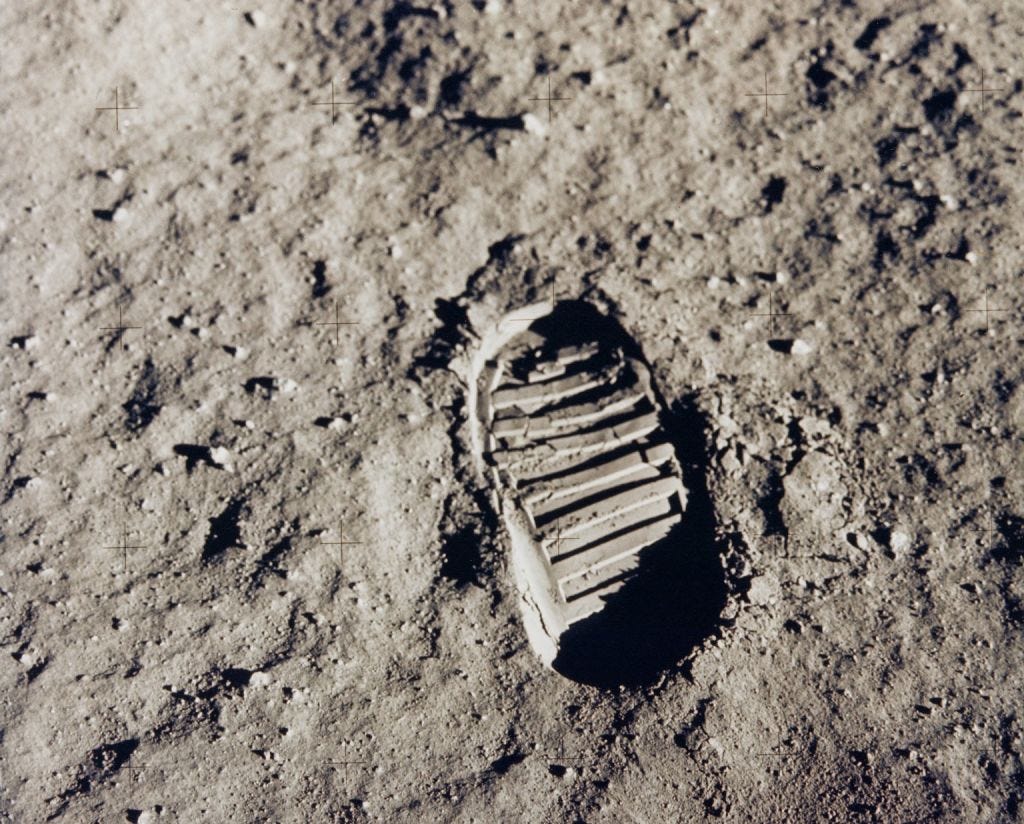
In May 1961, just weeks after Soviet cosmonaut Yuri Gagarin became the first human to orbit Earth, President John F. Kennedy addressed Congress with an audacious proposal: to land a man on the Moon and bring him safely back to Earth before the end of the decade. This bold goal set the stage for one of humanity’s greatest achievements, realised eight years later when Neil Armstrong and Buzz Aldrin took their historic steps on the lunar surface. But not everyone was convinced it was worth the effort. In early 1962, 13-year-old Mary Lou Reitler wrote to President Kennedy, questioning the morality of spending billions on space exploration while people on Earth faced hunger and hardship. Her letter is below, followed by a reply that arrived from Myer Feldman, Kennedy’s Deputy Special Counsel.
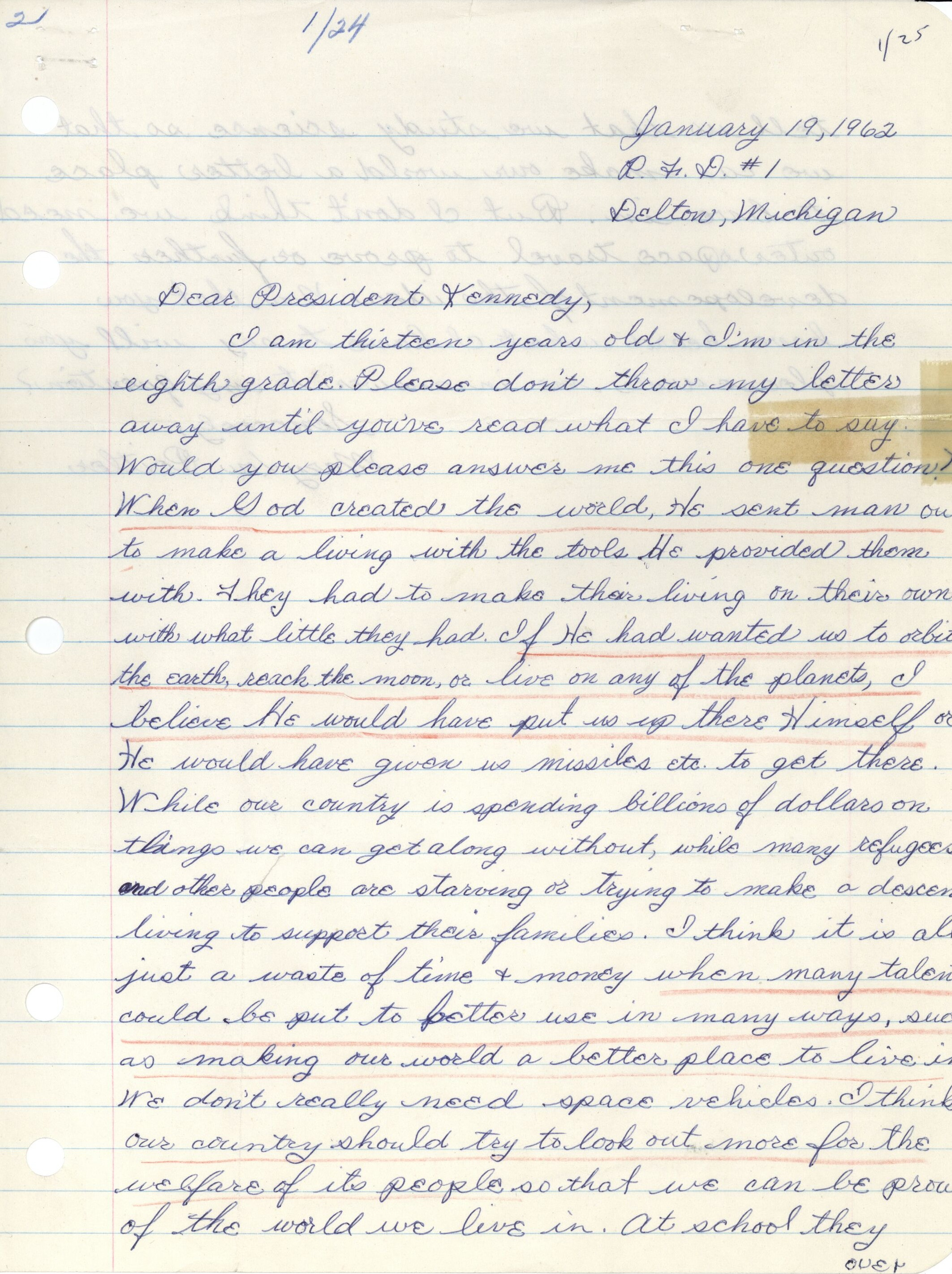
January 19, 1962
Dear President Kennedy,
I am thirteen years old and I’m in the eighth grade. Please don’t throw my letter away until you’ve read what I have to say. Would you please answer me this one question? When God created the world, He sent man out to make a living with the tools he provided them with. They had to make their living on their own with what little they had. If he had wanted us to orbit the earth, reach the moon, or live on any of the planets, I believe he would have put us up there himself or he would have given us missiles etc… to get there. While our country is spending billions of dollars on things we can get along without, many refugees and other people are starving or trying to make a decent living to support their families. I think it is all just a waste of time and money when talents could be put to better use in many ways, such as making our world a better place to live in. We don’t really need space vehicles. I think our country should try to look out more for the welfare of its people so that we can be proud of the world be live in. At school they tell us that we study Science so that we can make our world a better place to live in. But I don’t think we need outerspace travel to prove or further the development of this idea. Now that you have heard what I have to say, will you please write an answer to my question?
Sincerely,
Mary Lou ReitlerDear Mary Lou Reitler:
The President has asked me to reply to your letter asking why the United States expends so much time and energy in exploring space, and suggesting that God would have provided man with the necessary space implements had he wanted man to explore space.
A significant feature of our society is the right of each individual to determine the nature of God’s intent in accordance with his own conscience. I would not, therefore, presume to suggest how you should resolve the issue you pose in your letter. Yet it would appear that among the most common characteristics of man is a desire to impose change on nature in order to mollify the hardships of life. This, combined with an endowed natural intelligence and curiosity, has allowed man to progress through increased knowledge from the most primitive past when the only tools utilized were those rocks and sticks found lying on the ground, to the present day, when disease-controlling drugs, efficient food production, and labor-saving machinery have combined to permit man, if he wishes, to pursue a far richer and more humane life.
It is impossible to determine in advance, moreover, those benefits which will eventually result from a given advance in human knowledge. History is replete with examples of man pursuing knowledge with no expectation of any practical use, which later serve as the basis for developments making significant contributions to mankind. Janssen’s work on lenses, without his realising it, provided the breakthrough required to understand and control disease-causing microbes; also, Horts predicted that his academic experimentation with electromagnetic waves would have no practical or useful results, but he had in fact helped to lay the groundwork for the modern electronic industry.
Astronaut John H. Glenn briefly summed this up recently when he explained his views on the importance of space research before a joint session of Congress. He in part said, “But exploration and the pursuit of knowledge have always paid dividends in the long run—usually far greater than anything expected at the outset… Any major effort such as this results in research by so many different specialities that it is hard to even envision the benefits that will accrue in many fields. Knowledge begets knowledge. The more I see, the more impressed I am—not with how much we know—but with how tremendous the areas are that are as yet unexplored.”
Thank you very much for advising the President of your views on this important matter. It is encouraging to find someone of your age showing such interest and concern in public affairs.
Sincerely,
Myer Fieldman
Deputy Special Counsel to the President
Support Letters of Note…
Related…
Why Explore Space?

In 1970, a Zambia-based nun named Sister Mary Jucunda wrote to Dr. Ernst Stuhlinger, then-associate director of science at NASA’s Marshall Space Flight Center, in response to his ongoing research into a piloted mission to Mars. Specifically, she asked how he could suggest spendin…
What a wonderful post. I hope we will continue basic scientific research in the coming years.
This letter has been used as the basis for several educational lesson plans over the years. However, it would be interesting to know how this young woman herself viewed the response and the achievements of - and benefits derived from - the space program over the course of her lifetime. Unfortunately, it appears she passed away in 2022.