


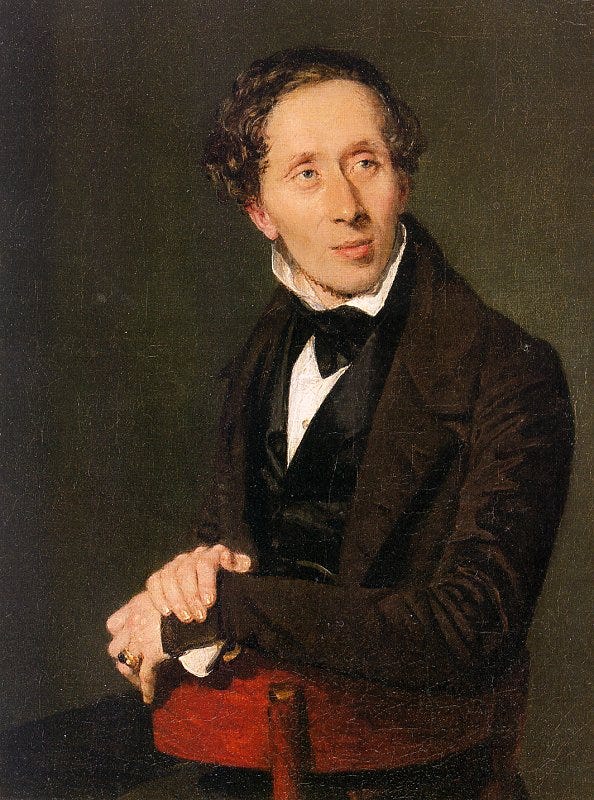

In 1830, a young Hans Christian Andersen, not yet famous for his fairy tales, fell deeply in love with Riborg Voigt, the sister of his friend Christian. However, she was already engaged to another man, leaving Andersen heartbroken. Two years later, Andersen learned that Voigt believed he was still writing about her in his poetry, and that this was causing difficulties in her marriage. Andersen wrote the following letter to her brother in an effort to set the record straight.
When Andersen died 43 years later, a small pouch containing a long letter from Riborg was found on his chest. Whatever she had written, we will never know: that letter was burned by his friend, Jonas Collin.
Christmas 1832
Dear Christian,
What you told me yesterday has deeply upset me. No, that isn’t quite right. It has made me bitter.
If you write to her about this, please point out that such things appear in the work of almost every poet. Indeed, precisely the same situations can be found in the poetry of Heine and Wilhelm Müller. But perhaps she believes that those poets were writing about her, too!
A poet must write about love! Such feelings will appear in everything I write, for as long as I live. So ask her to read my poems for what they are: poetry. Or am I supposed to give up being a poet altogether?
What I love is an ideal: the memory of a girl who once showed me something more than ordinary friendship. It is that ideal I dream of, that I write about, and that will live on in my poetry. How can a sensible married woman imagine that I am writing about her? That I wish to disturb the peace of her marriage? Surely it is a kind of vanity to suppose that every word I write, every thought I have, must concern her.
As I have said, I would have to stop being a poet altogether if I were forbidden to write anything that she might imagine was about her.
I loved Riborg. But I never think of the woman she is now: Madame Bøving. I wish she would do the same with me, and see a poet where she now imagines she sees a lover.
I would despise myself if I ever tried to destroy the happiness of two people. Besides, I have too much respect for her husband, and for the way he has regarded the whole affair, to wish him to become my enemy.
So tell her about Heine and Wilhelm Müller, and ask her to see only the poet, and nothing more. That is all I am, and all I ought to be.
Yours
HCA
The original letter is held at H. C. Andersen Centret, Odense. Many thanks to Susanne Roberts.